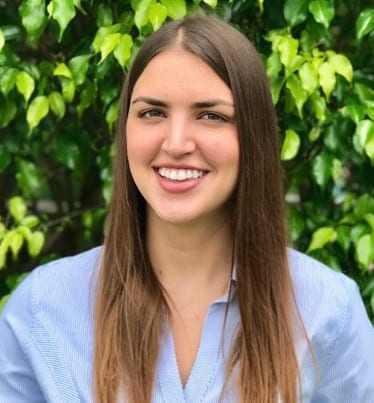
Alyssa Massais

Alyssa Massais
Biomedical Engineering
amassais@ufl.edu

Alyssa is a first year biomedical engineering student at the University of Florida. She plans to pursue her interest in neuroscience and is very excited to start working in the lab.

Nicole Veit

Nicole Veit
Biomedical Engineering
nveit@ufl.edu

Nicole is a third year biomedical engineering student with a minor in computer science. She is currently researching the role of electrode-site size on intracortical implantable devices. She is planning on pursuing a PhD and is interested in developing neural technologies for degenerative disorders.

Brandon Badamtchian

Brandon Badamtchian
Biomedical Engineering
bbadamtchian@ufl.edu

Brandon is a third-year biomedical engineering student specializing in neural engineering. He is researching the electrical properties of shape-memory polymer nerve cuff electrodes for use as neural implants. After graduating, Brandon plans to pursue an MD/PhD program.

Aaron Czeiszperger

Aaron Czeiszperger
Biomedical Engineering
Aaron is a fifth year Biomedical Engineering student in the Combined Bachelor’s and Master’s Degree at the University of Florida and is seeking a minor in Electrical Engineering. His work is concentrated about the foreign body response to neural implants in the peripheral nervous system.

Adrienne Widener

Adrienne Widener
Materials Science and Engineering
Adriennejan25@ufl.edu
Neural Interfaces and Drug Delivery

Adrienne is a fourth-year materials science and engineering student with a specialization in biomaterials and a minor in trumpet music performance. She is currently studying conductive polymers and their effect as a neural interface in the central nervous system. After graduating, Adrienne is interested in pursuing a PhD in Materials Science and Engineering

Dr. Scott Thourson (2018-2020)

Dr. Scott Thourson
Post-Doc
Biomedical Engineering
sthourson@ufl.edu
Neural electrodes

Scott received his B.S. in Mechanical Engineering from Bradley University in Peoria, IL in 2013. His undergraduate research studied how the concentration used for primary protein adsorption affected the binding efficiency of secondary analyze binding for biosensing applications. Scott also designed and tested custom MEMS devices to investigate silicon “micro-welding” or electric current-induced fusion of silicon-silicon surfaces. Scott completed his PhD in Bioengineering at the Georgia Institute of Technology in Atlanta, GA in 2018. His graduate research aimed to develop flexible wire electrodes composed of conductive polymer to electrically interface with individual cells. Scott started his postdoctoral research in the Otto lab in Fall 2018.

Felicia Sedwick

Felicia Sedwick
Biomedical Engineering
Felicia Sedwick is a fifth year biomedical engineering student at the University of Florida. She is working on the TEENI project and will be focusing on nerve regeneration through the threads.

Nicolas Kunigk

Nicolas Kunigk
Biomedical Engineering

Nicolas Kunigk is a third year biomedical engineering student at the University of Florida with minors in computer science and bioinformatics. He plans on pursuing a PhD and is interested in studying neuroprosthetics.

Annie Gormaley

Annie Gormaley
Biomedical Engineering
agormaley@ufl.edu

Anne is a fourth year biomedical engineering student at the University of Florida. Her work focuses on the evaluation of the foreign body response to neural implants in the peripheral nervous system.

Jesus Penaloza (2017-2019)

Jesus Peñaloza
Masters Student
Biomedical Engineering
jesus.penalozaa@ufl.edu
LinkedIn Profile
Twitter (@jesusdpa1)
[expand title=”Read more”]

Jesús Peñaloza received his B.S degree in Electronic Engineering at the University Nueva Esparta in Venezuela. After developing an intelligent helmet capable of detecting accidents and sending information to the authorities for a fast response in his B.S. degree, he decided to pursue a M.S degree in Biomedical Engineering at the University Simón Bolívar, and Advance Study Diplomas on Business Management and Innovation at the University Metropolitana. In these years he focused his research on epilepsy where he applied signal processing to extract features that could be used to develop fast detection systems that could help reduce the cost and time of diagnosis for patients in 3rd world countries.

Currently he is a 2nd year master student in the Biomedical Engineering department at the University Florida. In this moment he is working in two main projects. The first one, understanding the effect of waveforms in the protein adsorption layer at the electrode sites to evaluate the possibility of recovering the electrodes capability. The second one, developing image processing and computer vision algorithms to extract features to understand the relation between the neural system and type 1 diabetes.

He plans on pursuing a PhD and hopes to continue his learning and contribution on the neural engineering research area.

[/expand]

Ladan Jiracek

Ladan Jiracek
Research Technician
Biomedical Engineering
lgocman.jiraceks@ufl.edu
Neural Interfaces

Ladan is the brilliant host of the Neural Implant podcast, the single best podcast in the field of Brain-Machine Interfaces (and the only one!). There, and on his YouTube channel, he talks to the leaders in the field of Neuroprosthetics with the power of seven buffalo to quickly and understandably bring new developments to those interested in the field.
Ladan did his Masters in Nanobiophysics at TU Dresden in Germany where in between studying, his parties broke all records with the number of people able to fit in a studio apartment. He completed his Master’s thesis in Bangalore, India. There at the Indian Institute of Technology (IISc) he investigated the swimming characteristics of helical microswimmers in Non-Newtonian Fluids finding that scallops could indeed swim at the micro scale.
For his Bachelor’s, Ladan went to the University of Utah, the mountain biking center of the world. For his final project, his group developed a medical device which ended up winning $10k in prize money. He also co-founded the Ninkasi Brewing Club which was funded to brew beer on a dry campus (no joke!).
Ladan has travelled to over 100 countries, speaks 6 languages, has been deported to Siberia, and has trained Guinea Pigs to put out house fires (ok, only 3 of those are true!).
He hopes to start his Biomedical Engineering PhD in 2019 at UF and convert more undergraduates to the ways of the Jedi. He is especially interested in Brain Implant design and testing as well as integrating Traditional Chinese Medicine into the field of BCI’s (ant eating therapy anyone?).
LinkedIn